Introduction
Rajesh owns a manufacturing company in Pune. Over the past few years, sales have grown steadily, but so have expenses. Hiring more people seemed like the only way to keep up with customer demand. Every month, invoices piled up, reports took days to prepare, and managers spent hours chasing updates from different departments. Yet when Rajesh reviewed the financial statements, he struggled to explain why profits weren't growing at the same pace as revenue. The problem wasn't obvious because it wasn't a single large expense. It was hundreds of small inefficiencies quietly draining money every day.
This story is familiar across Indian SMEs. Owners often focus on negotiating lower supplier prices or reducing overheads while overlooking the hidden cost of repetitive work, delayed decisions, manual data entry, and disconnected systems. According to a report by McKinsey, generative AI and automation technologies have the potential to significantly improve productivity across business functions, creating substantial economic value for organizations that adopt them. The opportunity is often less about replacing people and more about helping them spend time on work that actually moves the business forward.
AI Impact on Business Cost Savings
Many business leaders associate artificial intelligence with futuristic robots or complex software projects. In reality, some of the highest returns come from everyday operational improvements. AI can read invoices, classify expenses, summarize meetings, draft customer responses, predict inventory shortages, and generate reports in minutes instead of hours. Each task may save only a few minutes, but when multiplied across employees and departments, the savings become meaningful. Time saved is money retained.
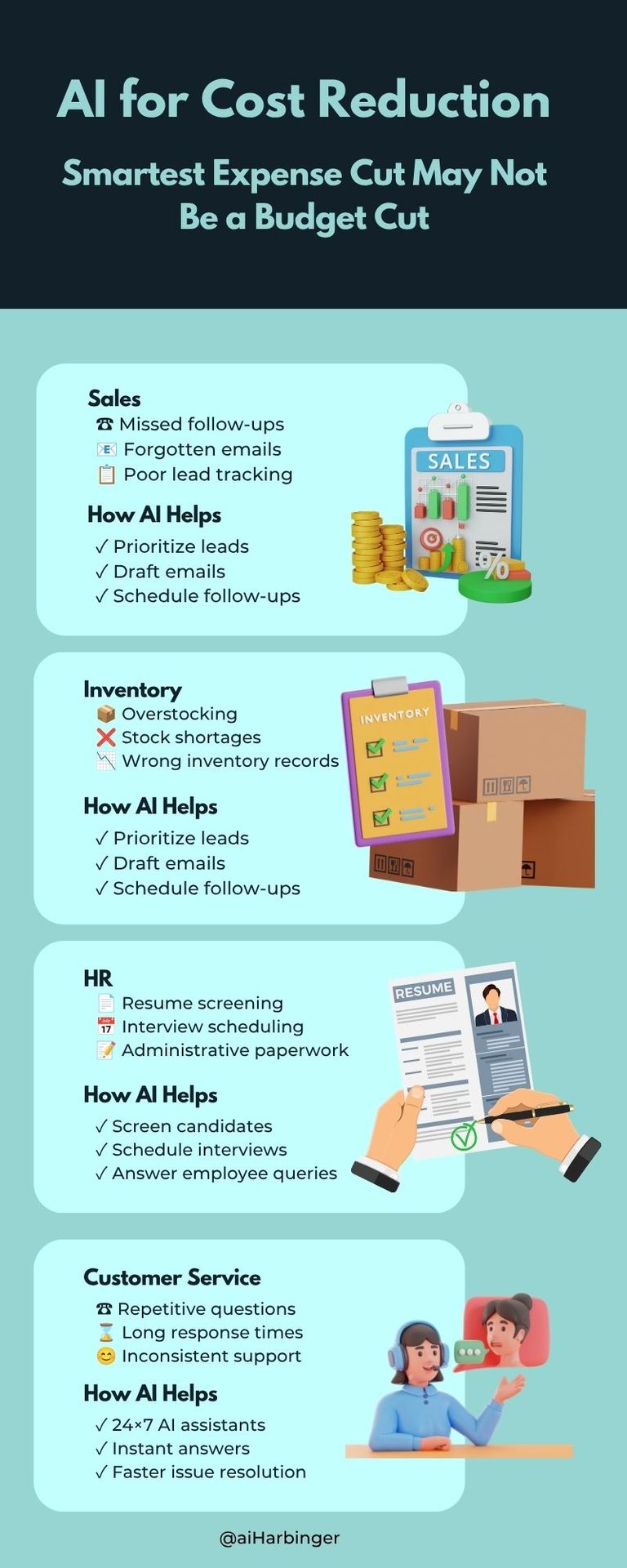
The financial impact extends beyond labour costs. Manual processes often create expensive mistakes that remain hidden until they affect customers or cash flow. Incorrect inventory records lead to excess stock. Delayed approvals slow procurement. Missed follow-ups reduce collections. Duplicate data entry increases the likelihood of errors. AI helps reduce these losses by processing information consistently and alerting teams before small issues become costly ones.
Customer service offers another example. Many SMEs receive similar enquiries every day about product availability, order status, quotations, or support requests. AI-powered assistants can handle routine conversations around the clock while directing complex issues to employees. This shortens response times without requiring a proportional increase in headcount. Deloitte's research has found that organizations using AI in customer service have improved efficiency while allowing employees to focus on higher-value interactions.
Finance teams also benefit from AI in ways that directly affect profitability. Instead of manually compiling reports from multiple spreadsheets, AI can consolidate financial information, identify unusual transactions, highlight spending patterns, and generate management summaries. Leaders spend less time collecting numbers and more time discussing actions. Better visibility often leads to faster corrective decisions before costs spiral out of control.
The biggest savings, however, rarely come from one impressive AI application. They emerge gradually as businesses remove friction from everyday operations. Employees waste less time searching for information. Managers receive timely insights instead of outdated reports. Processes become more predictable, and customers experience fewer delays. These improvements strengthen margins without sacrificing growth or service quality.
The AI Mindset
Technology alone does not create these outcomes. Businesses first need to understand where inefficiencies exist and which processes deserve attention. That requires a clear view of workflows, responsibilities, and data movement across the organization. At aiHarbinger, we help Indian SMEs identify these opportunities by streamlining business processes and aligning AI with practical business objectives, ensuring technology delivers measurable value instead of becoming another software investment.
Reducing costs has never been only about spending less. It has always been about running the business better, eliminating waste, and making every employee more effective. As AI becomes increasingly accessible to SMEs, the question is no longer whether the technology is affordable, but whether your business can afford to ignore the savings it could already be delivering?
Frequently Asked Questions
1. How does AI reduce business costs?
AI automates repetitive tasks, minimizes errors, and improves operational efficiency, helping businesses lower costs without compromising productivity.
2. Will AI replace employees in SMEs?
No. In most SMEs, AI complements employees by handling routine work, allowing them to focus on higher-value activities.
3. Which business functions benefit most from AI?
Finance, customer service, sales, HR, procurement, inventory management, and operations often see the quickest returns from AI adoption.
4. Is AI affordable for small and medium businesses?
Yes. Many AI tools are available on subscription models, making them accessible without large upfront investments.
5. Where should an SME start with AI?
Start by identifying repetitive, time-consuming processes and implementing AI where it can deliver measurable business value quickly.