Last few months I have been obsessed with AI Agents and here’s what I built and learnt.
First let me share my take on “Will AI take away our jobs?”
The simple answer is, I don’t know. Even after 100s of hours studying it, I don’t have a concrete answer. Let elaborate with an example. Suppose you are working in the marketing function of a chemical manufacturing company and looking for a domain expert for your marketing department. You think it will add more ‘weight’ to your copies and content which in turn attract more customers. Also note that currently there is no one person with that back ground in your team. After a few deliberations and meetings the boss tells you to manage the copy and content using AI. Here’s the tricky part to understand. Although AI ‘took away’ the job of some imaginary candidate, the reality is that job was never posted. So, in my opinion, the cliche “AI will not take your job, somebody who knows AI might” is true to some extent. So learning AI is non-negotiable.
Let’s try to understand what is AI and try to separate facts from fiction.
So first of all AI is almost as old as computing itself and its development started back in the 1950s itself. I was lucky to read Genius Makers, a book on evolution of AI, even before ChatGPT broke into the scene. Reading the book is highly recommended.
Anyways here are 3 broad applications of AI
Machine Learning: A subfield of AI where computers automatically learn from experience. It uses algorithms to find patterns in data and make predictions without being explicitly programmed.
Natural Language Processing (NLP): A specialized area that enables computers to understand, interpret, and manipulate human language. It powers tools like translation apps, chatbots, and voice assistants.
Deep Learning: An advanced type of machine learning inspired by the human brain. It uses layers of artificial neural networks to process complex data like images, audio, and video.
To understand how these AI applications we need to understand
Data: The raw information and examples used to train the AI. Just as humans learn from experience, AI models consume vast amounts of data to recognize patterns, make predictions, and learn over time.
Algorithms: The step-by-step mathematical rules and instructions that tell the machine how to process data. These models analyze input data, identify underlying trends, and make decisions without needing explicit, step-by-step programming for every scenario.
Computing Power: The heavy-duty processing capability required to train and run complex AI models. Running algorithms against massive datasets demands high-performance processors (like GPUs and TPUs) in order to function efficiently.
A common narrative that is commonly heard is that you need to start from the basics of statistics and probability. In my opinion this is neither desirable nor feasible for most of us. Just think about it. If you want to drive a car, do you need to know how the Internal Combustion engine works. No, right. So if you are a beginner and looking to incorporate simple AI apps into your workflow, you don’t need to go into statistics, different types of regression and how the neural networks work.
Since I started early, a few years before ChatGPT released, I had dived into it. I enjoyed learning but if you are not interested and don’t have the time then you can easily skip.
So this brings us to the question, where should we start from?
But before I answer that let me simply explain what is the difference between LLM chatbot and AI Agent is.
An LLM chatbot is designed primarily to textually converse and answer questions based on its training data, whereas an AI agent is designed to autonomously execute multi-step tasks and make decisions by interacting with external tools and systems and may have it’s own memory.
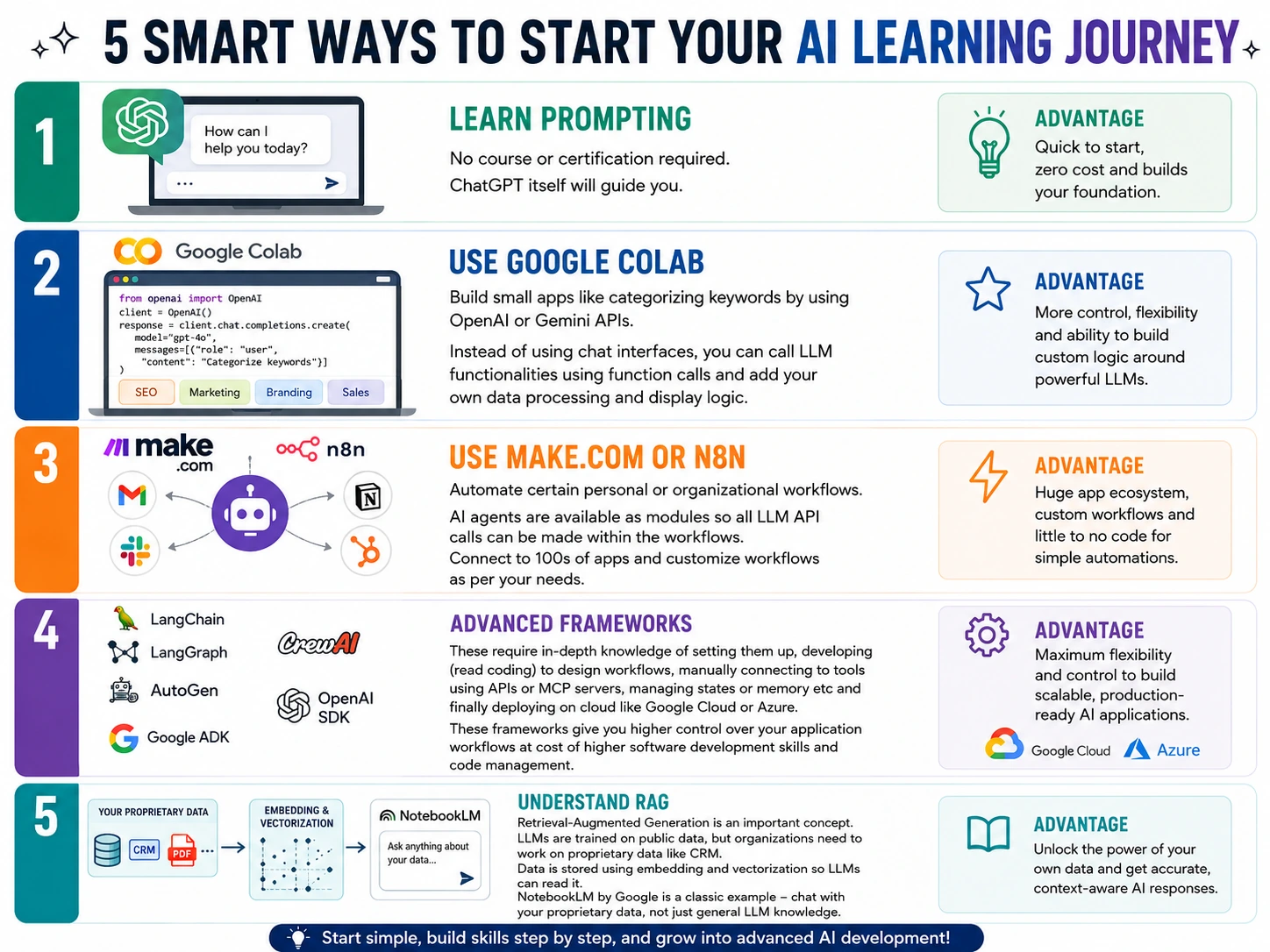
Now coming to my learning sequence suggestion, I propose the following.
- Learn prompting. No course or certification required. ChatGPT itself will guide you.
- Use Google Colab to build small apps like categorizing keywords by using OpenAI or Gemini APIs. The advantage is that instead of using chat interfaces, you are able to call the functionalities of these LLMs using a function call and also add your own data processing and display logic.
- Use make .com or n8n to automate certain personal or organizational workflows. AI agents have been added as module so all LLM API calls can be made from within the workflows. The advantage is you can connect to 100s of apps and customize your workflow as per your organizational needs. There is very little or almost no code required in simple workflows.
- Langchain, LangGraph, CrewAI, Autogen, ChatGPT SDK or Google ADK are advanced frameworks which require in-depth knowledge of setting them up, developing (read coding) to design workflows, manually connecting to tools using APIs or MCP servers, managing states or memory etc and finally deploying on cloud like Google cloud or Azure. These frameworks give you higher control over your application workflows at cost of higher software development skills and code management.
- RAG (Retrieval-Augmented Generation) is an interesting concept and you need understand it but not necessarily implement it at code or database level. Since LLMs are trained on public data and all organizations need to work primarily on propriety data like their CRM, there is a need to store the propriety data in a way so that LLMs can read them. This is done through embedding and vectorization and the base concepts are again maths and statistics here. Notebook LM from Google is a classic application where you can chat with your propriety data instead of general chat with LLMs.
My AI Agent Implementation using make .com
I implemented a simple workflow using make .com using AI Agent. The objective of the project was as follows.
- The workflow (called scenario in make .com) was tasked with reading multiple Youtube transcripts separated from a Google Doc by specific set of characters.
- All the transcripts are captured in an array variable which is read one by one and fed into an AI Agent module.
- The AI Agent using a prompt formats the transcript and gives output in a specific layout in a Google Doc which can be used as content on social media or website.
The benefit of using this make scenario using AI Agent is as follows.
- I don’t need to enter prompt and transcript into an LLM every time to format the transcript
- I get a very fast response and greater the number of transcripts, higher is the ROI in terms of time saved.
The world of AI is changing fast and even the fastest learners are having a tough time keeping up. What one should learn depends on the person’s role in the organization, seniority and level of interest. Most paid courses I have researched or enrolled into are very detailed and advanced and may not be suitable for most of us. Each platform including make .com have free courses which are self starters and takes your from beginner to intermediate level. Practicing these platforms is as important as understanding the theory behind them.