Rajesh ran a precision engineering factory just outside Pune. Orders were flowing in, but his internal operations were quietly fracturing under the weight of manual tracking. Hoping to fix the operational chaos, he invested tens of lakhs into a modern cloud ERP platform. Six months post-purchase, the system sat barely half-configured, supervisors on the factory floor were secretly logging production details in paper registers, and billing delays were straining vendor relationships.
Rajesh’s experience mirrors a widespread struggle across industrial belts from Pimpri-Chinchwad to Ambattur. According to industry research by Magicworks, nearly 80% of SME digital transformation initiatives in India fail to yield meaningful business outcomes. Globally, Gartner estimates that between 55% and 75% of ERP implementations fall short of their original business targets. The core problem is rarely defective software; rather, business owners buy sophisticated digital tools expecting plug-and-play success, without having a guided execution roadmap. That missing bridge is precisely what a Software Implementation Partner provides.
Assess the Business Process
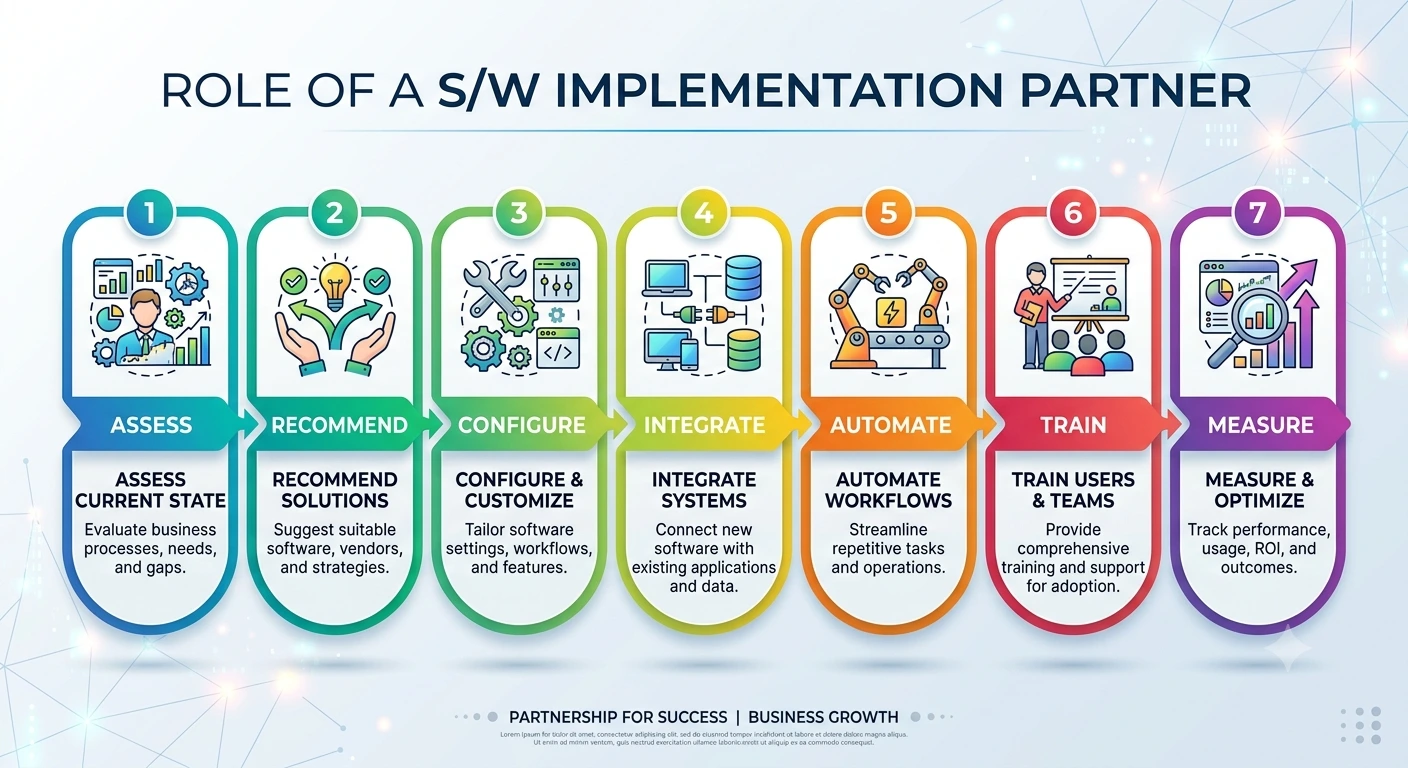
A qualified implementation partner begins by observing real operations on the ground rather than pushing software licenses. They shadow floor managers, examine dispatch logs, and track how customer inquiries move across desks. This diagnostic phase uncovers informal workarounds and communication gaps that never show up in official company chart diagrams. Catching these hidden friction points early keeps leadership from accidentally encoding bad operational habits into expensive software.
Once baseline workflows are clear, the partner helps standardize operations before configuring any software settings. Indian SMEs frequently rely on tribal knowledge held by senior workers, causing significant variation in daily execution across shifts. Establishing clear standard operating procedures at this stage prevents the business from digitizing existing confusion. It creates a clean, predictable operational foundation capable of supporting rapid scaling down the line.
Recommend the Right Software
Software sales reps excel at presenting impressive feature lists, yet growing companies usually utilize a small fraction of what they purchase. An independent partner evaluates prospective platforms strictly against your budget, staff technical readiness, and realistic three-year growth targets. They steer executive teams away from heavy enterprise software when modular platforms or targeted SaaS suites fit actual operational needs far better.
Selecting software also requires checking hardware requirements, GST compliance features, and data security standards. A trusted consultant calculates the true total cost of ownership, factoring in recurring licensing fees, server hosting expenses, and vendor support contracts. This realistic financial assessment prevents unexpected budget spikes, keeping capital expenditure aligned with projected cash flow.
Configure and Implement It
Out-of-the-box software seldom fits an SME’s specific operating model without adjustment. Implementation specialists set up custom data fields, define user permission tiers, design approval workflows, and tailor executive dashboards to mirror operational reality. They carefully balance necessary custom changes against long-term system stability, steering leaders away from excessive code modifications that could make future platform updates difficult.
Deploying new software all at once can disrupt ongoing sales and order fulfillment. Experienced specialists mitigate this risk through phased rollouts or running parallel test environments alongside existing tools. By creating sandbox environments where department heads test core transactions safely, the team validates data accuracy while keeping daily business operations running smoothly.
Integrate with Existing Systems
Most established SMEs depend on legacy tools like Tally for accounting, specialized inventory utilities, or custom Excel spreadsheets. Requiring employees to manually re-enter data across separated platforms increases human error rates and creates operational lag. An implementation partner designs custom API connections and automated data bridges, allowing legacy systems and new software suites to exchange information automatically.
Unifying data sources removes disconnects between sales promises and real-time inventory counts in the warehouse. Management gains immediate visibility into overall financial health, pending dispatches, and procurement status without waiting for manual weekly reports. This connected infrastructure keeps departmental silos from restricting business growth as order volumes increase.
Automate Repetitive Work
Manual tasks such as creating GST invoices, issuing payment follow-up notifications, and entering sales leads consume hundreds of productive hours every month. Implementation experts construct automated routines using system triggers or integration tools like n8n, taking routine data entry off employee desks entirely. Streamlining these repetitive processes reduces operational errors while speeding up response times for prospective clients.
Automation ultimately aims to redirect human focus toward higher-value business activities. When administrative staff no longer copy information between disparate spreadsheets, they focus on pursuing sales opportunities and improving client satisfaction. Over time, these efficiency gains increase revenue capacity per employee without inflating fixed overhead costs.
Train Users
Introducing unfamiliar software often creates anxiety among staff members who fear technical difficulties or altered job roles. Implementation partners address these concerns by delivering practical, role-based training modules in regional languages instead of generic video tutorials. They help shift employee attitudes by demonstrating how the new platform reduces daily administrative burdens.
Sustainable adoption requires more than a single orientation seminar. Effective partners organize hands-on training sessions, produce simple reference guides, and provide direct support during initial go-live weeks. Continuous coaching prevents employees from falling back on old habits or off-the-books spreadsheets once executive oversight returns to normal routine.
Measure Adoption and ROI
Installing software represents only part of the journey; long-term financial returns depend on consistent system utilization. Implementation partners establish measurable usage indicators, such as daily active user rates, order processing speeds, and data accuracy scores. McKinsey research indicates that digital initiatives lose up to 35% of their potential value during execution if performance monitoring drops off after launch.
Comparing baseline performance data against post-launch metrics gives leadership clear visibility into operational improvements. Founders can track reduced inventory holding costs, faster billing cycles, and improved order fulfillment times with precision. Regular performance reviews help refine system settings as the business expands, turning technology investments into measurable margin growth.
Conclusion
Scaling an SME in India's competitive market requires operational agility that manual tracking and spreadsheets can no longer provide. Software gives companies the engine to grow, but executive leadership must ensure the foundation is built correctly from day one. Working alongside a dedicated software implementation partner bridges the gap between buying digital tools and building an efficient, resilient business.
Navigating system design, software selection, and change management requires practical, on-the-ground expertise tailored to your operational environment. Are you ready to eliminate operational bottlenecks and scale your business seamlessly, or do you need help with Software Implementation Services from aiHarbinger?
Frequently Asked Questions
Q1: What is the main role of a software implementation partner for an SME?
An implementation partner evaluates business processes, selects suitable software, configures system settings, trains staff, and manages change to ensure maximum operational ROI.
Q2: Why do software implementations often fail in Indian SMEs?
Implementations usually fail due to inadequate process mapping, lack of user training, resistance to change, and attempting to fit off-the-shelf software without proper customization.
Q3: How long does a typical software implementation project take for an SME?
Depending on business complexity and scope, most SME software implementations take between 8 to 16 weeks from initial assessment to live deployment.
Q4: Can new software integrate with legacy systems like Tally?
Yes, implementation partners build API connectors and custom data pipelines to link modern platforms seamlessly with existing legacy tools like Tally.
Q5: How can an SME owner measure the ROI of software implementation?
ROI is measured by tracking operational KPIs such as reduced order turnaround time, lower inventory carrying costs, faster billing cycles, and improved employee productivity.