Introduction: The Cost of a Disorganized Workplace
Imagine a manufacturing unit in Pune that has built a reputation for delivering quality components. Orders are increasing, new machines have been installed, and the company has hired more workers. Yet, on a typical Monday morning, a production supervisor spends fifteen minutes looking for a measuring instrument. An operator discovers an oil leak that has been present for days. A batch of components is delayed because the correct tools are unavailable, while the production manager struggles to understand why yesterday's output fell short.
None of these problems appears serious enough to threaten the business on its own. Over several months, however, the lost time, avoidable defects, equipment issues and delivery delays begin to affect profitability. The owner responds by investing in new machinery or hiring more people, hoping that additional capacity will solve the problem.
But what if the business already has much of the capacity it needs and is losing it through the way work is organised?
This is where 5S can make a difference. Developed from Japanese workplace practices and closely associated with Lean manufacturing, 5S helps organisations establish orderly, visible and repeatable ways of working. For Indian SME owners and CEOs, it offers a practical starting point for improving quality, safety and productivity without immediately committing to expensive technology or large-scale operational restructuring.
How 5S Became Part of Toyota's Operational Culture
5S is closely associated with the Toyota Production System (TPS), although it is more accurate to view it as an important practice within the broader evolution of Japanese manufacturing rather than a method invented in isolation by Toyota. The TPS aims to eliminate waste, shorten lead times and deliver high-quality products at lower cost. Its two central pillars are Jidoka, which builds quality into the process, and Just-in-Time, which produces what is needed, when it is needed, in the required quantity.
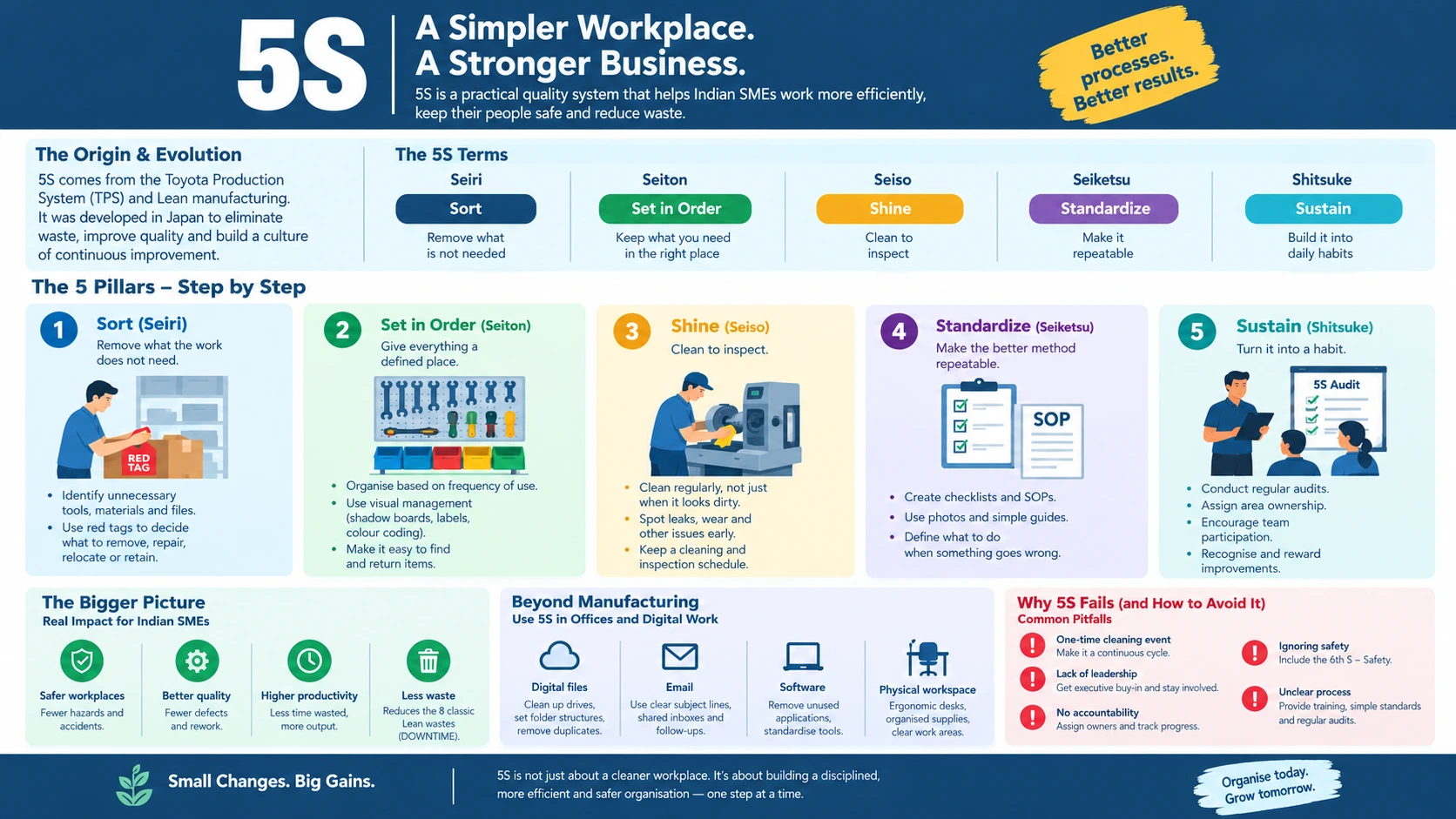
The five Japanese terms are Seiri, Seiton, Seiso, Seiketsu and Shitsuke. They are commonly translated as Sort, Set in Order, Shine, Standardize and Sustain. Each addresses a practical workplace problem: unnecessary items, misplaced materials, hidden abnormalities, inconsistent practices and the failure to maintain improvements. Together, they make the workplace easier to understand and manage.
The significance of 5S lies in the way it makes problems visible. When tools have designated locations, missing equipment is immediately noticeable. When floors and machines are kept clean, leaks and unusual wear become easier to detect. When the correct procedure is displayed at the workstation, deviations are more apparent. The workplace begins to provide information about how well the process is functioning, rather than leaving managers to discover problems after production or delivery has suffered.
For an SME, this is particularly valuable because the owner and a handful of experienced employees often carry considerable operational knowledge in their heads. As the business expands, informal arrangements become harder to manage. 5S helps convert individual habits into shared working practices that new employees can learn and follow.
Deconstructing the Five Pillars: A Practical Implementation Guide
Sort (Seiri): Remove What the Work Does Not Need
Begin by examining one production line, maintenance area, store or office rather than attempting to reorganise the entire business. Identify the tools, materials, documents and equipment required for daily work. Items that are unnecessary, obsolete, damaged or rarely used can be marked with red tags so that someone can decide whether to remove, repair, relocate or retain them. A red-tag area can temporarily hold items awaiting a decision, with a responsible person and a deadline assigned to each.
This exercise often reveals more than excess inventory. A workshop may contain obsolete fixtures, duplicate tools or rejected components that have occupied valuable space for years. An office may retain outdated forms and multiple versions of the same report. Removing these items reduces clutter and frees up space, while the decisions made during sorting can also expose weak purchasing, inventory-control or document-retention practices.
Set in Order (Seiton): Give Everything a Defined Place
Once unnecessary items have been removed, organise what remains according to how frequently it is used and where it is needed. Tools used every hour should be close to the operator; specialist equipment used occasionally can be stored elsewhere. Shadow boards, labelled racks, marked storage locations and colour coding make the arrangement visible. Ergonomic considerations matter too: frequently handled items should be easy to reach, and heavy materials should not require unsafe lifting.
The test is simple: can an employee locate the right item quickly and return it to its proper place without asking a supervisor? If the answer is no, the arrangement needs improvement. In an Indian SME with multiple shifts or frequent staff changes, a consistent system reduces dependence on individual memory and makes handovers more reliable.
Shine (Seiso): Clean to Inspect
Cleaning should become an opportunity to inspect equipment and the workplace. While wiping a machine, an operator may notice a loose bolt, an oil leak, a damaged cable or unusual vibration. Such observations can be recorded and passed to maintenance before the problem causes an unexpected breakdown or quality issue.
Define what needs cleaning, how often it should be done and who is responsible. A short daily inspection may be sufficient for a small workstation, while equipment with more demanding maintenance requirements will need a separate schedule. Cleaning does not replace preventive maintenance, but it helps employees recognize abnormal conditions earlier and gives supervisors a clearer view of equipment health.
Standardize (Seiketsu): Make the Better Method Repeatable
After the first three steps, document the arrangements that work. Photographs of an ideal workstation, short standard operating procedures (SOPs), cleaning schedules and checklists can help employees maintain the expected condition. Standards should be easy to understand and practical enough to follow during a busy shift.
A standard should also explain what happens when something goes wrong. If a tool is missing or an oil leak is discovered, the employee should know whom to inform and how the issue will be tracked. Supervisors can use brief checks to verify compliance and revise the standard when the process changes. Otherwise, the improvements achieved during the initial exercise will gradually disappear as production demands increase.
Sustain (Shitsuke): Turn the Practice into a Habit
Sustaining 5S requires regular attention from management and participation from the people doing the work. Assign area ownership, conduct scheduled audits and discuss recurring problems during routine team meetings. A simple scorecard can track whether items are stored correctly, cleaning standards are followed and previously identified issues have been resolved.
The purpose of an audit is to improve the system, not to embarrass employees. If the same problem appears repeatedly, management should investigate whether the standard is practical, the required resources are available and responsibilities are clear. Recognition for useful suggestions and visible action on employee feedback can build ownership. Over time, 5S becomes part of how the organisation manages work rather than an activity performed only before a customer visit.
Beyond Manufacturing: Applying 5S to Offices and Digital Work
Although 5S is widely associated with factory floors, its principles are equally relevant to administrative and knowledge-based work. In a typical SME office, employees may maintain duplicate spreadsheets, save documents in inconsistent folders, use overlapping software applications and spend time searching for the latest version of a file. These problems create delays even when the physical workplace looks perfectly tidy.
Digital 5S starts by removing redundant files, outdated templates and unused applications, while retaining records required for legal, contractual and operational purposes. Next, establish a consistent folder structure, naming convention, document ownership and access permissions. Shared drives should make it clear where approved documents belong and which version is authoritative. Email workflows can also be improved through clear rules for subject lines, shared mailboxes, follow-ups and task ownership.
The same thinking applies to physical offices and hybrid working arrangements. Employees need an ergonomic workspace, reliable access to essential equipment and a consistent way to store shared resources. Teams working across locations benefit from documented procedures that do not depend on being physically present beside an experienced colleague.
For SMEs, the larger opportunity is to connect workplace organisation with process improvement. Before purchasing new software to solve a coordination problem, examine whether the underlying workflow is clear. Automating a poorly organised process may simply make the existing inefficiency happen faster.
The ROI of 5S: Measuring Safety, Quality and Waste Reduction
The business case for 5S should be assessed through operational evidence rather than assumptions about how much tidier a workplace has become. Research published in the International Journal of Productivity and Performance Management examined 203 Indian manufacturing plants and found a positive relationship between 5S use and operational performance measures, particularly quality and productivity. The findings support its potential value, although a positive relationship does not establish that 5S alone caused every improvement.
A separate 2026 study of garment manufacturing units in Tiruppur reported that around 55% of the organisations examined had implemented 5S only partially. The researchers identified financial constraints, insufficient training and weak top-management support among the major challenges. This offers a useful lesson for SME leaders: understanding the method is relatively straightforward, but maintaining it requires organisational commitment.
A further study of automotive manufacturing in Tamil Nadu reported a 24.1% increase in productivity, a 48.2% reduction in defects and a 10.7% improvement in machine uptime after deploying a combination of Lean tools, including 5S, Kaizen, Total Productive Maintenance and value stream mapping. These are encouraging results, but they should not be presented as the isolated effect of 5S because multiple interventions were used together.
For an individual SME, the most useful starting point is its own baseline. Record the average time taken to find frequently used tools, the number of workplace hazards identified, defects and rework per production batch, machine downtime and the time spent searching for documents. Also measure the space occupied by obsolete materials and the frequency of delays caused by missing items. After implementation, compare the same measures over an appropriate period and calculate the value of time saved, reduced rework and avoided downtime.
5S also helps address the eight classic Lean wastes, often remembered through the acronym DOWNTIME: defects, overproduction, waiting, non-utilised talent, transportation, inventory, motion and extra processing. Organised work areas can reduce unnecessary movement and searching, while clearer standards help prevent avoidable errors. The method will not eliminate every form of waste by itself, but it creates the visibility needed to identify where further improvements are worthwhile.
Safety deserves equal attention. Unobstructed aisles, properly stored materials, clear access to emergency equipment and the removal of unnecessary clutter can reduce exposure to workplace hazards. Some organisations add a sixth S for Safety, making hazard identification and safe working practices an explicit part of the program. Safety should remain integral to every stage, whether or not it is counted as a separate pillar.
Why 5S Initiatives Fail: Avoiding the Spring-Cleaning Trap
A common mistake is to launch 5S with a major cleaning drive, take photographs of the improved workplace and then move on to the next priority. A few months later, tools are misplaced again, unwanted materials accumulate and audit scores become a formality. The underlying reason is often that management has treated 5S as a housekeeping assignment instead of a way to improve everyday work.
The solution begins with executive involvement. Owners and CEOs should explain the business problem being addressed, participate in reviews and provide the time and resources required to maintain standards. Employees need training, clear responsibilities and an opportunity to suggest better arrangements. If production targets make it impossible to complete inspections or return tools to their locations, management must resolve that conflict instead of blaming the workforce.
Start with one area where the problem is visible and measurable. Establish its baseline, implement the five steps, review the results and extend the approach once the new practices are stable. Keep audits short enough to be useful, assign corrective actions to named owners and review whether recurring problems have been resolved. Recognition should reward meaningful improvements and sustained participation, not merely the best-looking workstation.
The same discipline applies to service and administrative processes. A business can standardize document management, clarify approval responsibilities and remove redundant steps before introducing more sophisticated digital tools.
aiHarbinger helps SMEs streamline business processes by identifying operational gaps, improving workflows and supporting practical management and technology improvements suited to their business needs. Reach out to us learn how we can work together.
Conclusion: Make Better Work the Everyday Standard
For Indian SMEs, 5S provides a manageable starting point for building a more reliable organisation. It can improve visibility, help employees detect problems earlier and establish consistent practices as the business grows. Results will depend on the nature of the operation, the quality of implementation and the willingness of management to sustain the changes. Owners should begin with a real operational problem, measure the current position and give employees a meaningful role in improving the way work is done.
The question is not whether your workplace can look more organised for a day, but how much time, money and productive capacity could your business recover if better ways of working became the everyday standard?
Frequently Asked Questions
1. What is 5S in quality management?
5S is a workplace organization method built around Sort, Set in Order, Shine, Standardize and Sustain. It helps make work more orderly, visible and consistent.
2. Is 5S only for manufacturing companies?
No. Offices, warehouses, service businesses and digital teams can use 5S to organize documents, workflows, equipment and shared resources.
3. How does 5S improve productivity?
It reduces time spent searching for items, helps identify abnormalities and makes standard working methods easier to follow.
4. How long does 5S implementation take?
A pilot area can often be organized over a few weeks, depending on its complexity. Sustaining the improvements requires ongoing ownership, checks and follow-up.
5. What is the sixth S in 5S?
The optional sixth S stands for Safety. It makes hazard prevention and safe working practices an explicit focus alongside the original five principles.
References
Toyota Motor Corporation. Toyota Production System. Official Toyota website.
Kumar, M. (2022). Implementation of 5S in Indian Firms. IITM Journal of Management and IT, 13(1), 33–42. Study details.
Evaluating 5S implementation and challenges in garment manufacturing units: A study in Tiruppur district. Research Journal of Textile and Apparel (2026). Research article.
Lean tools deployment study in the manufacturing sector in the state of Tamil Nadu. Rajagiri Management Journal (2026). Research article.
Cunningham, J. (2020, January 18). The Eight Wastes of Lean. Lean Enterprise Institute. Read the article.
Lean Enterprise Institute. 5S. Lean glossary and explanation.
National Productivity Council, India. About 5S. Official resource.
Editorial note: The numerical findings above come from studies involving particular manufacturing settings. They are presented with their study context rather than as guaranteed results for every SME. Before publishing, it would also be worth checking the full text of the cited research papers if you want to include additional details about the study samples, methods or measured outcomes.