Introduction
A customer calls the owner of a growing manufacturing company and says, “The last batch was not like the previous one.” The production head says the material from the supplier was different. Purchase says they bought what was specified. Quality says the inspection report was within limits. Sales, meanwhile, is trying to calm the customer and protect the next order.
Nobody deliberately caused the problem. Yet the problem happened.
This is where quality becomes a management issue rather than a quality-department issue. As an SME grows, the number of people, suppliers, customers, machines, approvals and handovers increases. Small inconsistencies that were easy for the owner to catch at ₹5 crore turnover can become expensive problems at ₹25 crore or ₹500 crore. Rework, rejection, delays, complaints, returns and repeated firefighting start consuming management attention.
The financial impact can also be larger than it first appears. The American Society for Quality notes that the total cost of quality, including actual and hidden costs, can reach 25% of sales in some organizations. That does not mean every SME is losing 25% of its revenue to poor quality. It does mean that the cost of errors, rework, scrap, delays and prevention deserves to be treated as a business metric rather than an isolated operational problem.
For Indian SMEs, the subject is particularly relevant. A study of 127 Indian manufacturing SMEs found a positive relationship between TQM practices and manufacturing performance. The same study identified inadequate knowledge, lack of management willingness, returning to old ways of working, budget constraints and disruption to operations among the significant barriers to implementation.
TQM offers a way to address this problem systematically. The idea is simple: quality should be built into the way the organization is managed, rather than checked only after work has been completed.
Fundamentals of Total Quality Management
Total Quality Management, or TQM, is a management approach in which the entire organization works continuously to improve products, services and processes while meeting customer requirements.
The word “total” matters. Quality is influenced by sales, product design, purchasing, production, finance, logistics, customer service and leadership. A good inspection department cannot compensate for an unclear specification, unreliable supplier, poorly designed process or inadequate training.
The second important idea is prevention. Traditional quality control often asks, “Did we produce a defective product?” TQM asks a broader question:
“What in our system allowed the defect to occur in the first place?”
That shift moves the organization from detection towards prevention.
The third idea is consistency. A business may occasionally deliver an excellent product through the efforts of a highly experienced employee. That is not yet a quality system. A mature organization can produce the expected result repeatedly, even when people change, order volumes fluctuate or the owner is not personally supervising every activity.
ISO describes a quality management system as a collection of processes and procedures that helps an organization consistently deliver products and services that meet customer and regulatory requirements while supporting continual improvement. ISO also emphasizes the process approach: planning what needs to be done, carrying it out, checking the results and acting on what has been learned.
This is why TQM should not be confused with ISO certification.
ISO 9001 is a formal quality management standard, while TQM is a broader management philosophy.
An organization can pursue TQM without immediately seeking certification, and an ISO certificate by itself does not guarantee that an organization has developed a strong quality culture.
The scale of quality management globally is significant. ISO says the ISO 9001 standard has more than one million certificates issued across 189 countries, making it the world's most widely used quality management standard.
For an SME owner, however, the starting point does not need to be a large quality department or a mountain of documentation. It can begin with understanding where errors occur, why they occur, what customers actually expect and which processes have the greatest impact on business performance.
8 Principles of Total Quality Management (TQM)
For an SME-oriented TQM framework, communication is useful as an eighth principle because improvement cannot travel through an organization unless expectations, information and lessons are communicated effectively.
1. Customer Focus
Quality starts with understanding what the customer actually values.
An SME should identify customer requirements beyond product specifications. Delivery reliability, response time, documentation, service support, consistency and problem resolution can be equally important. Customer complaints should therefore be treated as information about the process rather than simply as problems to be closed.
2. Leadership Commitment
TQM cannot be delegated completely to a quality manager.
Employees quickly notice what senior management really rewards. If management talks about quality but pushes teams to prioritize output at any cost, the organization receives a clear message. The owner and senior team need to define quality priorities, allocate resources and review quality performance as seriously as they review sales, costs and cash flow.
3. Engagement of People
People closest to a process often understand its problems better than senior management.
Operators, supervisors, sales executives and service teams should have a mechanism to report recurring problems and suggest improvements. Training is important, but empowerment matters too. Employees need to understand not only what procedure to follow but why it exists and what they should do when the process does not produce the expected result.
4. Process Approach
A customer does not experience an organization department by department. They experience the result of a chain of processes.
An order moves from enquiry to quotation, order confirmation, planning, procurement, production, inspection, dispatch, invoicing and after-sales support. If each department optimizes only its own activity, the overall customer experience can still suffer. Process mapping helps management see handoffs, delays, duplication and points where errors enter the system.
5. Continual Improvement
TQM assumes that a process can always become better.
Improvement does not necessarily mean a major technology investment. It could mean reducing approval time, eliminating duplicate data entry, simplifying a form, improving machine maintenance, changing an inspection point or redesigning an approval workflow.
Small improvements accumulate. More importantly, they teach the organization to solve problems systematically rather than waiting for a crisis.
6. Evidence-Based Decision Making
A recurring quality problem should be investigated using evidence.
How many complaints occurred? Which products were affected? Which supplier supplied the material? At which stage did the defect appear? Has the frequency increased? What happened after the corrective action?
Data does not need to mean sophisticated analytics. A well-maintained check sheet, a simple trend chart or a Pareto analysis can reveal patterns that are difficult to see through anecdotal discussions.
7. Relationship Management
Quality depends on relationships beyond the company's own walls.
Suppliers influence incoming material quality. Logistics partners influence delivery performance. Distributors influence the customer experience. Technology providers influence system availability. For many SMEs, supplier quality can become especially important as the organization grows and its supply chain becomes more complex.
Relationship management means setting expectations, measuring performance and working with important partners to solve recurring problems.
8. Communication
A quality system can fail because the right information does not reach the right person at the right time.
A revised drawing that does not reach production, a customer specification that does not reach purchase, a recurring complaint that does not reach product design or a process change that is not communicated to the team can create avoidable failures.
For this reason, communication should be treated as part of the quality system. Information needs clear ownership, defined channels and a reliable way of reaching the people who need it.
8 Steps of TQM Implementation
The biggest mistake an SME can make is trying to implement TQM everywhere at once. A better approach is to start with the business processes where quality problems are creating the greatest operational or financial impact.
Step 1: Establish the Quality Direction
Start with the business, not the quality manual.
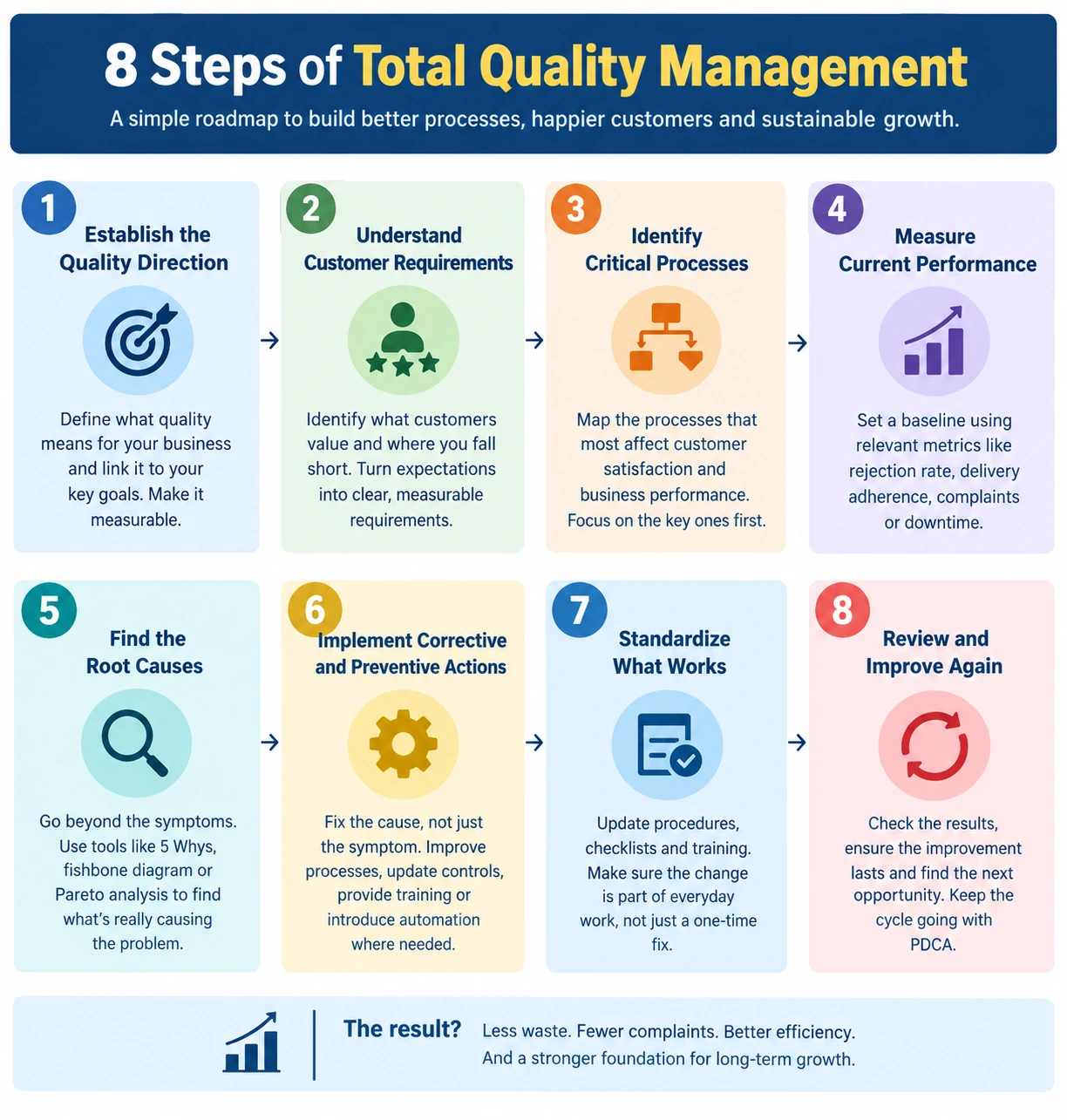
The leadership team should define what quality means for the company and connect it with business objectives. For one SME, it could mean reducing customer complaints. For another, it may mean improving on-time delivery, reducing rejection or achieving consistent service turnaround.
The objective should be measurable enough to track.
Step 2: Understand Customer Requirements
Identify what customers consider important and where the organization currently falls short.
Customer complaints, returns, warranty claims, delayed deliveries, lost orders, service escalations and feedback from sales teams can provide useful information. The aim is to convert customer expectations into measurable requirements.
Step 3: Identify Critical Processes
Map the processes that have the greatest influence on customer satisfaction and business performance.
Do not attempt to document every activity initially. Start with a few critical processes such as order-to-delivery, procurement, production, installation, service or complaint handling.
The purpose is to understand how work actually happens, rather than how management assumes it happens.
Step 4: Measure Current Performance
Once the process is visible, establish a baseline.
Useful measures could include rejection rate, rework hours, customer complaints, delivery adherence, first-pass yield, machine downtime, response time or repeat service calls. The right metric depends on the process.
Without a baseline, an improvement project can become a matter of opinion.
Step 5: Find the Root Causes
Fixing the symptom may provide temporary relief while leaving the underlying problem untouched.
Tools such as the 5 Whys and fishbone diagram can help teams investigate possible causes. Pareto analysis can help identify which problems deserve attention first. ASQ identifies these and other methods among the established quality tools used for process analysis and improvement.
Step 6: Implement Corrective and Preventive Actions
Once the cause is understood, change the process.
This could involve revising specifications, changing supplier controls, modifying a workflow, introducing a checklist, improving training, changing inspection points or automating a repetitive activity. The action should address the cause rather than simply instructing employees to “be more careful.”
Step 7: Standardize What Works
An improvement becomes valuable when it becomes the new way of working.
Update the relevant procedure, work instruction, checklist, system or training material. Make ownership clear. If the improvement exists only because one supervisor remembers it, the organization has not yet institutionalized the change.
Step 8: Review and Improve Again
TQM is a continuous cycle rather than a project with a final completion date.
Review the performance data, check whether the improvement has lasted and identify the next opportunity. The PDCA model, Plan-Do-Check-Act, is one established way of structuring this cycle. ASQ describes PDCA as a four-step problem-solving model for improving processes or implementing change.
Tools of Quality
TQM becomes practical when management has simple tools for understanding problems and making decisions.
The seven basic quality tools remain useful because most SMEs do not need complicated statistical systems to start improving. ASQ lists the traditional tools as the cause-and-effect diagram, check sheet, control chart, histogram, Pareto chart, scatter diagram and stratification, while noting that flowcharts and run charts are also commonly used in modern versions of the list.
Flowchart or Process Map
A process map shows how work moves from one step to another. It can expose unnecessary approvals, repeated data entry, unclear ownership and bottlenecks.
Check Sheet
A check sheet provides a simple structured method for collecting data. It can be used to record defects, complaints, downtime or other recurring events.
Pareto Chart
A Pareto chart helps management separate the significant problems from the long list of smaller issues. It is particularly useful when teams have many complaints or defect categories and need to decide where to begin.
Fishbone Diagram
Also called a cause-and-effect or Ishikawa diagram, this tool helps a team explore possible causes behind a problem instead of immediately blaming an individual.
Histogram
A histogram helps visualize how numerical data is distributed. It can help teams understand variation in measurements, process outputs or other performance data.
Control Chart
A control chart tracks process performance over time and can help distinguish normal process variation from signals that require investigation.
Scatter Diagram
A scatter diagram can help examine whether two variables appear to be related. For example, an SME may investigate whether machine temperature and defect rates appear to move together.
The important point is that tools should serve a business question. Using every quality tool simply because it is available can create unnecessary complexity. The Indian SME study found that inadequate knowledge and incorrect application of quality practices can themselves become barriers to TQM implementation.
Implementation Challenges for Indian SMEs
TQM sounds straightforward on paper. Implementation is where the real work begins.
A major challenge is management commitment. In the study of 127 Indian manufacturing SMEs, “lack of willingness from management” received a high barrier rating, second only to inadequate knowledge and know-how. Returning to old ways of working was another significant barrier.
This is understandable. SME owners are often managing sales, cash flow, customers, people and operations simultaneously. When a major customer issue appears, the immediate instinct is to solve it quickly. Taking time to examine the system behind the problem can feel like a luxury. Yet that short-term approach can cause the same problem to return.
Another challenge is limited resources. The study identified budget constraints and operational disruption as significant barriers. SMEs may worry about the cost of training, consultants, technology or process redesign. The answer is not necessarily to avoid quality improvement, but to start with the areas where poor quality has the clearest financial or customer impact.
People can also resist changes to established routines. An employee who has followed the same process for five years may not immediately see why it needs to change. If management introduces new forms, measurements and procedures without explaining the reason, TQM can quickly become associated with additional paperwork.
There is also the danger of confusing documentation with quality. A thick procedure manual does not automatically create a good process. If employees complete forms only because an auditor may ask for them, the system becomes a compliance exercise. Quality management works better when the documentation helps people perform their work consistently and make problems visible.
Finally, SMEs sometimes expect quick results from a long-term management discipline. TQM can produce early wins, but building a culture of prevention, measurement and continual improvement takes time. The objective should be to make improvement part of everyday management rather than running a short-lived quality campaign.
Conclusion: Making Quality a Way of Running the Business
For an Indian SME, TQM does not have to begin with a large transformation programme.
It can begin with one customer complaint that keeps recurring. It can begin with a process that depends too heavily on one employee. It can begin with rework that everyone has accepted as normal, a supplier problem that keeps returning or a management meeting where nobody has reliable data.
The important step is to stop treating these issues as isolated incidents and start looking at the system that produces them.
The evidence from Indian manufacturing SMEs provides a useful reason to take this seriously. Research involving Indian manufacturing SMEs found a positive relationship between TQM practices and manufacturing performance, while also showing that knowledge, leadership commitment, resources and resistance to changing established practices can determine how successfully the approach is adopted.
For an SME owner, the business case is ultimately about control. Better processes reduce dependence on individual people. Better information improves decisions. Fewer defects reduce waste and customer dissatisfaction. Consistent execution creates the foundation for growth.
This is also where technology can become useful, but only after the business understands what needs to improve. Digital tools can help standardize workflows, capture data, automate repetitive activities and make performance more visible, but technology should support a good process rather than automate a broken one.
For SMEs that want to take a structured look at their existing processes and identify opportunities for improvement, aiHarbinger helps organizations streamline business processes by combining management and digital capabilities to improve the way work is planned, executed and monitored. Reach out to us at sanad@aiharbinger.in
FAQs
1. What is Total Quality Management?
TQM is a company-wide management approach focused on customer satisfaction, consistent processes, employee involvement and continual improvement.
2. Is TQM the same as ISO 9001?
No. ISO 9001 is a formal quality management standard, while TQM is a broader management philosophy focused on building quality into the way an organization operates.
3. Can small businesses implement TQM?
Yes. SMEs can begin with a few critical processes and simple measurement and improvement practices instead of attempting a large organization-wide programme immediately.
4. What is the most important TQM principle?
Customer focus is central, but TQM works as a system. Leadership, people, processes, data, relationships and continual improvement all influence the result.
5. Which quality tool should an SME use first?
Start with the tool that matches the problem. A process map can reveal bottlenecks, a check sheet can collect reliable data, and a Pareto chart can help identify which problems deserve attention first.
Sources
ISO, ISO 9000 Family — Quality Management and Quality Management Principles.
ISO, ISO 9001:2026 — Quality Management Systems — Requirements.
American Society for Quality (ASQ), Cost of Quality.
American Society for Quality (ASQ), Seven Basic Quality Tools.
Sahoo, S. & Yadav, S., Total Quality Management in Indian Manufacturing SMEs, Procedia Manufacturing, 2018. Study of 127 Indian manufacturing SMEs.
Majumdar, J.P., Kundu, G.K. & Murali Manohar, B., Causes of reluctance of Indian manufacturing SMEs in adopting total quality management, International Journal of Services and Operations Management, 2019.