A customer places an order on Monday and expects delivery on Friday. The sales team says, “We can do it.” Production says, “We should be able to manage.” Purchase is already chasing a supplier, maintenance is hoping a machine does not stop, quality is trying to clear yesterday’s batch, and the owner is receiving calls from three different departments asking for decisions. Friday arrives, but the order is only partly ready. The customer may never see the internal chaos. They simply see a delayed delivery.
This is the challenge many Indian SMEs face as they grow. Customers expect better quality, shorter lead times, reliable delivery, competitive pricing and quick response. Meeting those expectations depends on what happens inside the business every day.
India's manufacturing sector continues to expand. The latest Annual Survey of Industries reported that industrial output grew by more than 5.8% in 2023-24, while employment increased by 5.92%. (Press Information Bureau) At the same time, the RBI's manufacturing survey covering 905 companies reported capacity utilisation of 74% in Q1 2024-25. (RBI System Health)
For an SME owner, however, growth brings a different question: Can the internal organisation keep up with what the market is demanding?
That is where internal business excellence becomes important.
What Does Internal Business Excellence Mean?
Internal business excellence is the ability of an organisation to consistently convert its people, machines, materials, information and processes into reliable business outcomes.
It shows up in practical measures: productivity, quality, delivery, inventory, equipment availability, project execution, safety and management discipline. These are connected. A machine breakdown can affect production; production delays can affect delivery; rushed production can increase defects; defects can create rework; rework consumes capacity that was already constrained.
The problem for many SMEs is that these issues are managed department by department. The production team focuses on output, quality focuses on rejection, purchase focuses on cost, maintenance focuses on breakdowns and management focuses on sales and cash flow. Each may be doing its job, while the overall business continues to lose efficiency.
Internal excellence requires looking at the complete chain.
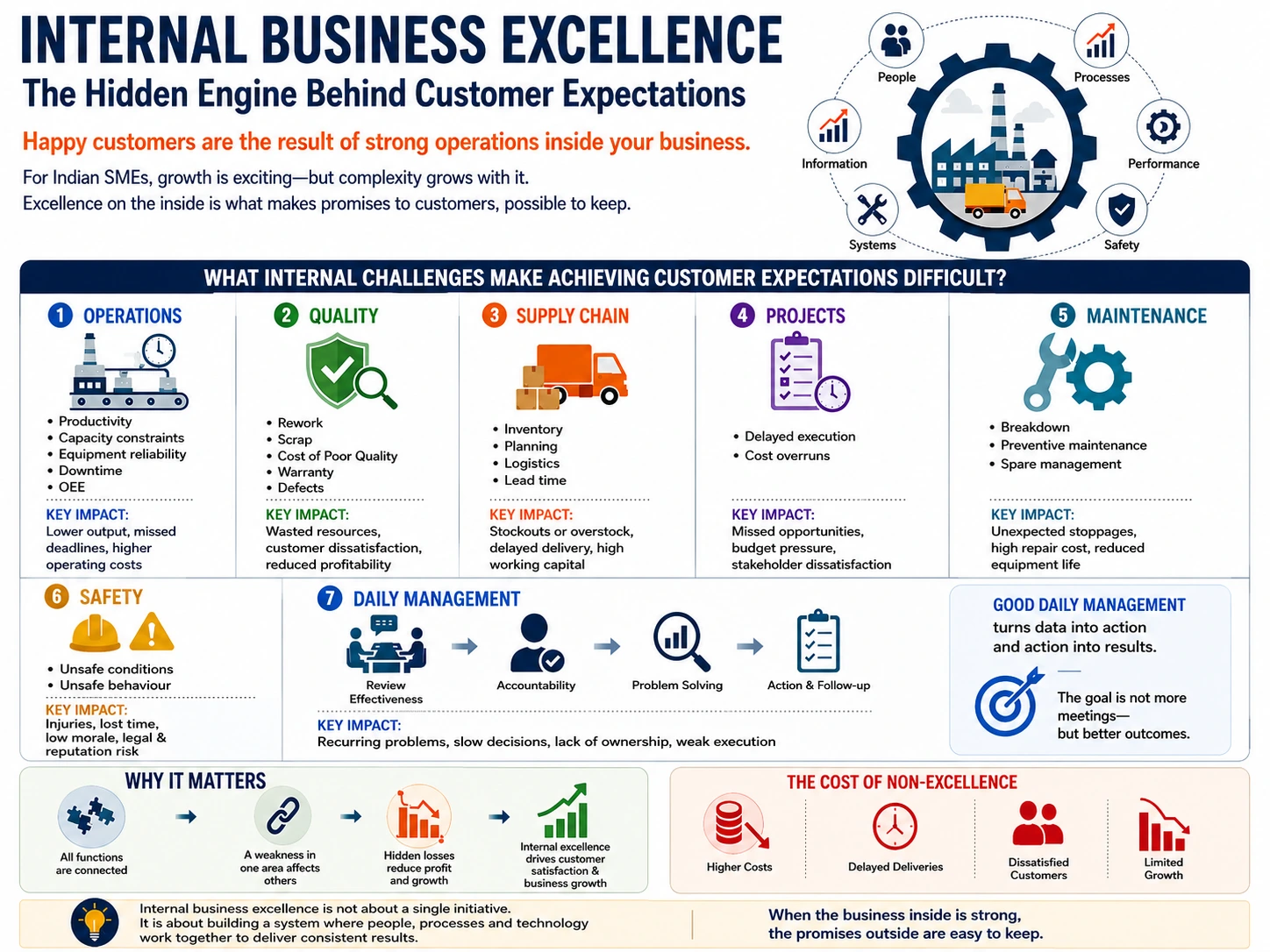
1. Operations: How Much of Your Capacity Are You Really Using?
A factory may have enough machines and people on paper and still struggle to meet customer demand.
Productivity is affected by waiting time, changeovers, material availability, operator practices, machine speed, absenteeism and inefficient processes. Capacity constraints may therefore be less about the number of machines and more about how effectively existing capacity is used.
This is where Overall Equipment Effectiveness (OEE) becomes useful. OEE combines availability, performance and quality to give a more meaningful picture of equipment effectiveness than simply asking whether a machine was running.
For perspective, RBI's latest manufacturing data shows capacity utilisation around the mid-70% range, although this is an economy-wide measure and should not be treated as a benchmark for an individual SME. (RBI System Health)
For an SME, the more useful questions are internal:
Where are the capacity bottlenecks?
How much production time is lost to downtime?
How much output is lost because machines run below their standard rate?
How much capacity is consumed by rework?
A factory that wants to grow without immediately investing in another machine needs to understand these numbers first.
2. Quality: The Cost of Getting It Wrong
Quality problems rarely end with the defective product.
A rejection can consume raw material, machine time and labour. Rework may require inspection, additional processing and rescheduling. A customer complaint adds another layer of cost through replacement, logistics, investigation and management attention.
This is why Cost of Poor Quality (COPQ) is a useful management concept. Instead of looking only at the rejection percentage, management should ask what defects are costing the business in rupees and lost capacity.
Research on Indian manufacturing has also highlighted defects and rework as operational constraints. A recent study of automotive assembly operations in India found strong agreement among respondents that product defects were an important constraint, with 93.7% agreeing or strongly agreeing that frequent defects were operationally significant. (Frontiers)
The bigger question is whether the organisation is preventing defects or repeatedly correcting them.
A mature quality system therefore looks beyond inspection. It examines process capability, root causes, standardisation, operator practices, corrective action and recurrence.
3. Supply Chain: Inventory Can Hide Operational Problems
Inventory creates an interesting dilemma for SME owners.
Too little inventory can stop production and delay customer orders. Too much inventory locks up working capital, increases storage requirements and can hide poor planning. Materials may be available somewhere in the warehouse while the required item is unavailable at the point of use.
A 2024 study of MSMEs in Himachal Pradesh found that poor inventory and forecasting practices could lead to excess inventory or stockouts, delayed delivery, customer dissatisfaction and reduced profitability. (EBSCO OpenURL)
Indian SME research involving 257 responding companies has similarly identified inventory management, cost reduction and lead-time reduction as important supply-chain concerns. (ScienceDirect)
For the owner, the issue goes beyond inventory levels. Planning accuracy, supplier reliability, purchase lead times, logistics, production scheduling and information flow all influence whether an order reaches the customer when promised.
Sometimes the fastest way to improve delivery is not to push the dispatch team harder. It is to fix what happens several steps earlier.
4. Projects: When Good Plans Take Too Long
Projects exist in almost every growing SME.
It could be installing a new machine, expanding a plant, implementing software, developing a new product, setting up a new production line or entering a new market. The expectation is usually clear: complete the project within the agreed cost and timeline.
Yet projects often accumulate small delays. A decision waits for approval. A vendor misses a date. A drawing changes. Material arrives late. An internal resource gets diverted to an urgent customer order.
Government project-monitoring data illustrates how significant the problem of execution can become at scale. In April 2024, 792 of 1,838 monitored ongoing projects were delayed against their original completion dates, while 448 had cost overruns. (IPM)
These are large infrastructure projects, not SME benchmarks. But the management lesson is relevant: execution discipline matters as much as planning.
For SMEs, clear milestones, ownership, escalation mechanisms, dependency tracking and regular reviews can prevent projects from becoming permanent “work in progress.”
5. Maintenance: From Firefighting to Reliability
Few things create more disruption on a shop floor than an unexpected breakdown.
The immediate impact is obvious: production stops. The less visible effects include missed schedules, overtime, idle manpower, expedited purchases and pressure on other machines. If the same equipment repeatedly fails, the organisation gradually starts planning around unreliability.
Indian research provides some useful perspective. A study of 64 reputed Indian process-industry companies found that 17% relied primarily on breakdown maintenance, while 39% followed preventive maintenance and 24% used predictive maintenance. (ResearchGate)
Another study of 216 Indian organisations examined barriers to implementing maintenance practices specifically in small and medium enterprises in northern India, reinforcing that maintenance capability is a significant SME management issue. (ScienceDirect)
Good maintenance therefore involves more than fixing machines quickly. Preventive schedules, condition monitoring, critical-spare management, maintenance history and root-cause analysis all influence equipment reliability.
The goal is to make breakdowns less of a surprise.
6. Safety: The Cost of Unsafe Conditions and Behaviour
Safety is sometimes treated as a compliance responsibility owned by one department.
In reality, safety is closely connected with operating discipline. Unsafe conditions can emerge from poor housekeeping, inadequate maintenance, unsuitable equipment, weak procedures or rushed work. Unsafe behaviour can develop when employees become accustomed to shortcuts because “we have always done it this way.”
Government data shows that workplace injuries remain a real concern. A 2026 Rajya Sabha response reported non-fatal injuries in registered factories across Indian states for 2020-2024; for example, Gujarat recorded 574 non-fatal injuries in 2024. (Digital Sansad)
For an SME, safety should therefore be part of daily operations rather than an annual compliance exercise.
The practical questions are straightforward: Are unsafe conditions identified quickly? Are near misses discussed? Are corrective actions closed? Do supervisors reinforce safe behaviour when production pressure increases?
A safe workplace is usually also a more disciplined workplace.
7. Daily Management: Are Meetings Producing Action?
Many SME owners spend considerable time in review meetings.
The problem is rarely the absence of meetings. It is what happens after them.
A review can become a discussion of yesterday's numbers without identifying today's actions. The same problem can appear week after week because nobody owns its resolution. Employees may report issues upward, but the organisation may lack a structured way to investigate causes, assign responsibility and verify closure.
Effective daily management creates a short operating rhythm around performance, abnormalities and action.
Production knows yesterday's output. Quality knows the major defects. Maintenance knows equipment availability. Purchase knows critical shortages. Managers know which problems need escalation.
The purpose is not to create more meetings or reports. It is to make problems visible early and ensure somebody owns the response.
That distinction matters enormously as a business grows.
Internal Excellence Is a Connected System
These areas should not be treated as independent improvement projects.
Suppose a company has poor production planning. It may carry additional inventory to compensate. High inventory then makes material visibility harder. Production gets interrupted by shortages despite a large warehouse. The team works overtime to recover the schedule. Rushed production increases quality problems. Maintenance postpones preventive work because machines are needed for urgent orders.
Each department may have a reasonable explanation.
The customer, however, experiences only one thing: the company is unreliable.
This is why internal business excellence requires a holistic view of the business. The objective is to identify how processes interact and where improvement in one area can remove problems elsewhere.
What Should an SME Owner Do First?
The answer is usually not to launch ten improvement initiatives simultaneously.
Start by understanding the current state.
Look at a small set of operational measures that reveal how the business actually works: productivity, capacity utilisation, downtime, OEE, rejection, rework, inventory, lead time, on-time delivery, project performance, maintenance compliance and open corrective actions.
Then identify where the biggest gap exists between expected and actual performance.
Most importantly, convert the numbers into questions.
Why is this happening? Where does the problem originate? Who owns it? What is the financial impact? What would improve if we fixed it?
This moves the organisation from reporting problems to solving them.
Conclusion: Build the Business Behind the Brand
Customers judge a company by what they experience: quality, delivery, responsiveness, consistency and value.
Those outcomes are created internally.
A growing Indian SME cannot depend indefinitely on the owner's intervention, experienced employees remembering how things are done, emergency follow-ups or heroic efforts to recover from problems. As complexity increases, the business needs stronger processes, clearer accountability, better performance visibility and a disciplined approach to solving recurring problems.
Internal business excellence is therefore less about introducing another management programme and more about making the business work better every day.
For SMEs that want to bring structure to this journey, aiHarbinger helps organisations examine their existing processes, identify operational gaps and streamline business processes so that management effort translates into more predictable execution and sustainable growth.
Reach out to us to discuss how we can help you in your business.
FAQs
What is internal business excellence?
It is the organisation's ability to consistently deliver good business outcomes through effective processes, people, equipment and management systems.
What is OEE?
Overall Equipment Effectiveness measures equipment performance through availability, performance and quality.
What is Cost of Poor Quality?
COPQ represents the costs associated with defects, rework, scrap, complaints, returns and other quality failures.
Why is daily management important?
It creates a regular mechanism to monitor performance, identify abnormalities, assign accountability and drive problem solving.
Where should an SME start?
Start with a current-state assessment, identify the most significant operational gaps and prioritise improvements based on business impact.