At 10:15 on a Monday morning, a production line stops. The operator calls maintenance. The maintenance supervisor looks for the right spare. Production waits. The dispatch team starts calculating how much of the day's schedule will be missed. Two hours later, the machine is running again, but the disruption has already travelled beyond the shop floor. A delivery may be delayed, overtime may increase, and another machine may have to compensate for the lost capacity. For an owner or CEO, the uncomfortable question is simple: How many such hours are quietly costing the business every month?
For manufacturers, equipment reliability is closely connected to productivity, quality, delivery and profitability. IBM estimates that unplanned downtime costs industrial manufacturers about US$50 billion annually, while one recent estimate puts the average cost of an hour of downtime at more than US$300,000 across surveyed organizations. These figures vary considerably by industry and plant, but they illustrate the economic importance of keeping critical assets productive.
What Is Total Productive Maintenance (TPM)?
Total Productive Maintenance is a systematic approach to improving equipment effectiveness by involving people across the organization in maintaining and improving equipment. The idea goes beyond the traditional model where operators produce and the maintenance department fixes machines when something goes wrong.
TPM brings equipment care closer to everyday production. Operators learn to identify abnormalities, maintenance teams work proactively, managers focus on recurring losses, and improvement teams investigate the causes behind poor performance. The objective is to reduce breakdowns, losses, defects and other forms of equipment-related waste while making better use of existing assets.
For an SME, this distinction matters. Buying another machine is often easier to consider than asking why the current machine is available for only part of the time it could be producing.
The Core Objective: Maximizing Equipment Effectiveness
The central question in TPM is not simply, “Is the machine running?” It is “How effectively is the machine producing what the business needs?”
A machine may be running but producing below its designed speed. It may stop frequently for minor issues. It may produce defective parts. It may require lengthy changeovers. These losses reduce the productive capacity of an asset without necessarily appearing as a major breakdown.
TPM therefore looks at equipment effectiveness from a broader perspective. The objective is to systematically identify losses, understand their causes and remove them rather than accepting them as a normal part of manufacturing.
The Eight Pillars of TPM
The eight pillars provide a framework for putting TPM into practice:
- Autonomous Maintenance develops equipment ownership among operators.
- Focused Improvement attacks specific losses.
- Planned Maintenance creates a structured maintenance system.
- Quality Maintenance connects equipment conditions with defects.
- Early Equipment Management scientifically designed and introduced with input from maintenance data to ensure immediate reliability and easy upkeep.
- Training and Education develops the capabilities required to sustain the system.
- Safety, Health and Environment optimizes workplace conditions to eliminate hazards and achieve a target of zero accidents and zero pollution.
- Office TPM applies lean principles to streamline information flow, scheduling, and overall office efficiency.
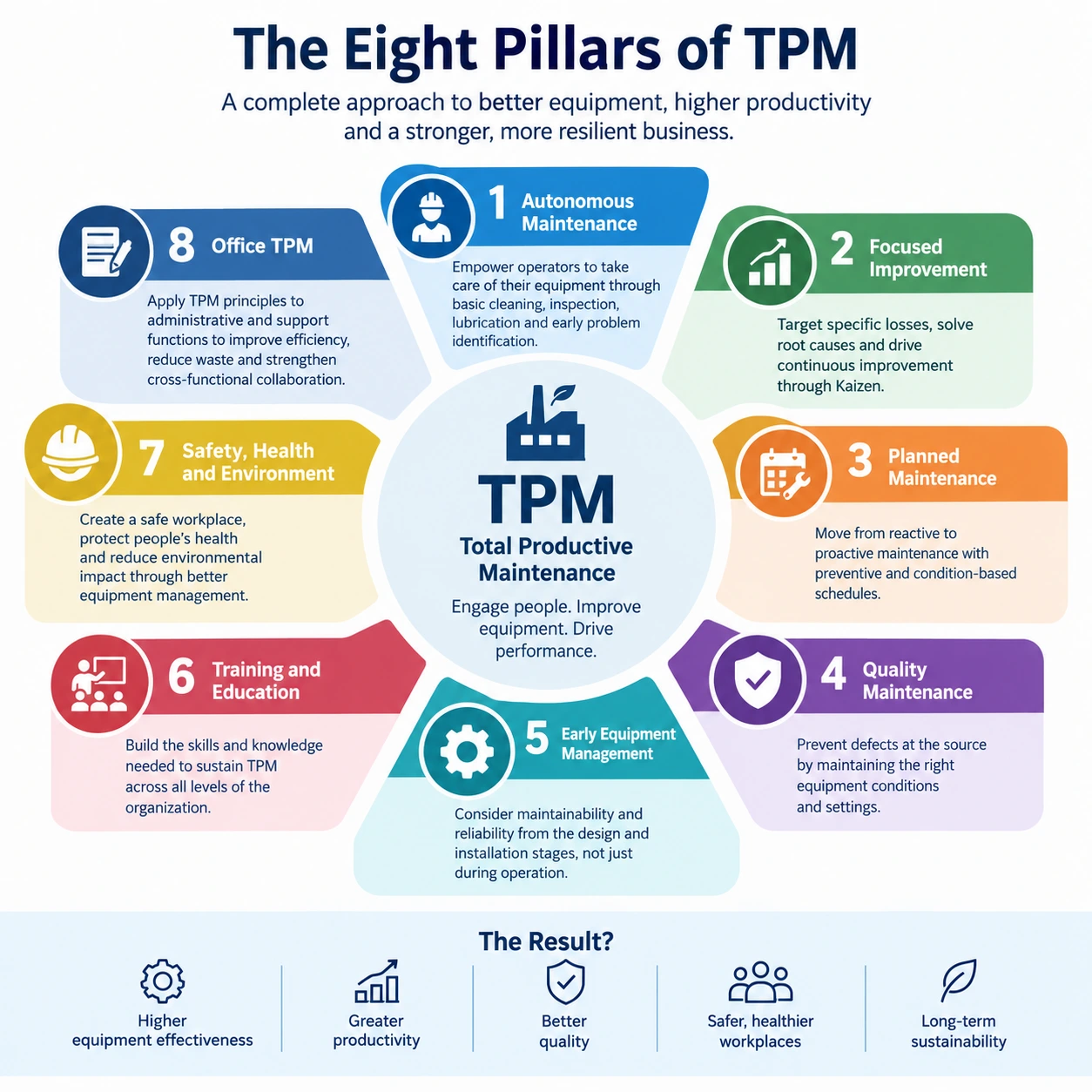
For a smaller manufacturing organization, the eight pillars do not necessarily mean launching eight separate initiatives simultaneously. TPM works better when the organization establishes the fundamentals, measures losses and gradually builds the discipline.
Overall Equipment Effectiveness: Measuring What the Machine Is Really Delivering
One of the most useful measures associated with TPM is Overall Equipment Effectiveness (OEE). OEE looks at three dimensions:
- Availability: How much planned production time was actually available?
- Performance: How fast did the equipment run compared with its potential?
- Quality: How much of the output met the required quality standard?
The formula is:
OEE = Availability × Performance × Quality
A commonly referenced benchmark is 85% OEE as “world class” for discrete manufacturers, while around 60% is described as fairly typical and 40% is not uncommon for manufacturers without TPM or lean programs. These figures should be treated as reference points rather than universal targets because equipment, processes and industries differ.
The real value of OEE for an SME is often diagnostic rather than comparative. A falling OEE number tells management that something is being lost; breaking it into availability, performance and quality helps identify where to investigate.
Autonomous Maintenance: Making Operators Responsible for Equipment Care
Operators are usually the people closest to a machine. They hear unusual sounds, notice vibration, see leaks, observe changes in product quality and know when a machine is behaving differently.
Autonomous Maintenance gives operators responsibility for basic equipment care such as cleaning, inspection, lubrication and identification of abnormalities, while specialist maintenance remains responsible for technical work requiring appropriate expertise.
This changes the relationship between production and maintenance. Instead of waiting for a failure and then calling maintenance, problems can be detected earlier. Operators also develop a better understanding of how equipment condition affects production performance.
Planned Maintenance: Preventing Breakdowns
Reactive maintenance is familiar: something fails, production stops and someone fixes it. The problem is that the organization is then operating according to the machine's failure schedule rather than its production schedule.
Planned maintenance moves the organization towards scheduled preventive and condition-based activities. Critical equipment can receive more attention, spare parts can be prepared in advance and maintenance work can be scheduled around production requirements.
IBM notes that research involving 100 large enterprises found unplanned downtime cost 35% more per minute than planned downtime. The exact economics will differ for an SME, but the underlying management principle remains relevant: an organization has considerably more control over a planned intervention than an unexpected failure.
Focused Improvement and Kaizen
TPM does not assume that every loss requires a major investment. Often, the biggest opportunities are hidden in recurring small problems.
Focused Improvement uses structured problem-solving to identify significant losses, investigate their root causes and implement targeted improvements. A recurring machine stoppage, excessive setup time, repeated adjustment or persistent quality problem can become a specific improvement project.
This is where Kaizen becomes practical. Instead of asking employees to “improve productivity” in general terms, management can ask a team to eliminate a particular loss and measure the result.
Quality Maintenance: Preventing Defects at the Source
Quality maintenance connects equipment condition with product quality.
A defect may appear to be a production problem, but its underlying cause could be equipment wear, incorrect settings, temperature variation, vibration or another machine-related condition. If the same defect keeps returning, simply inspecting more finished products does not address the source.
The TPM approach is to understand the equipment conditions required to consistently produce quality output and maintain those conditions. This reduces dependence on detection and rework by preventing problems earlier in the process.
Training, Skills and Employee Involvement
TPM depends on people who understand both the equipment and the processes around it.
Operators need the skills to recognize abnormalities and perform basic care. Maintenance personnel need technical and analytical capabilities. Supervisors need to understand equipment losses and improvement metrics. Managers need to create the time and accountability required to sustain the system.
This is particularly important for SMEs where knowledge can sometimes reside with a few experienced employees. Building broader capability reduces dependence on individuals and makes operational knowledge easier to retain as the organization grows.
Safety, Health and Environment
A machine that produces efficiently but creates unacceptable safety risks is not a successful TPM outcome.
Safety, health and environmental considerations therefore need to be incorporated into equipment operation, maintenance activities and improvement projects. Preventive maintenance can also contribute to safer operations by identifying deteriorating equipment conditions before they create larger risks.
TPM's focus on equipment condition consequently has implications beyond uptime. It connects operational discipline with the conditions under which people work.
Common Challenges in TPM Implementation
Many TPM initiatives struggle because organizations treat TPM as a maintenance department project. Another common problem is focusing on checklists and activities without measuring whether equipment performance is actually improving.
There can also be resistance from operators who see additional maintenance responsibilities as someone else's job, maintenance teams that remain trapped in reactive firefighting, or management teams that expect quick results without changing routines. Poor data creates another difficulty: if downtime, minor stops and defects are not recorded consistently, teams may end up improving what is most visible rather than what causes the greatest loss.
The answer is usually not more complexity. It is disciplined implementation, clear ownership, reliable measurement and visible management support.
TPM as a Culture, Not Just a Maintenance Program
The word “Total” in Total Productive Maintenance is important because equipment performance cannot be owned by one department alone.
Production, maintenance, quality, engineering, stores, procurement and management can all influence equipment effectiveness. A spare part that is unavailable can extend downtime. Poor operating practices can accelerate deterioration. Inadequate training can create recurring problems. A procurement decision can affect maintainability years after a machine is purchased.
When these connections become part of everyday management, TPM moves from a maintenance initiative to an organizational way of working.
TPM and Sustainable Business Performance
The business case for TPM ultimately comes down to getting more reliable output from the assets the company already owns.
McKinsey reports that predictive maintenance applications can reduce machine downtime by 30–50% and increase machine life by 20–40%, although these results come from specific applications and should not be assumed as universal TPM outcomes.
For an SME, the opportunity may begin much more simply: understand where production time is being lost, measure the losses, involve the people closest to the equipment, fix recurring causes and establish routines that prevent the problem from returning.
That foundation can later support digital monitoring, predictive maintenance, analytics and other Industry 4.0 initiatives. Technology becomes considerably more useful when the underlying processes and responsibilities are already understood.
Conclusion
TPM is ultimately about changing the way a manufacturing organization thinks about its equipment. Machines are business assets, and their performance affects capacity, quality, delivery, cost and customer commitments. A disciplined TPM approach helps organizations move from reacting to breakdowns towards understanding and eliminating the losses that prevent equipment from delivering its full potential.
For Indian SMEs, this does not necessarily require a large technology investment or a complicated transformation program. It can begin with one critical machine, reliable measurement, operator involvement, planned maintenance and a small number of focused improvement projects. Over time, those practices can become part of the operating culture and create a stronger foundation for sustainable growth.
If your machines could consistently deliver more from the capacity you already have, how much more could your business achieve?
Frequently Asked Questions
1. What is TPM?
TPM is a company-wide approach to improving equipment effectiveness by combining proactive maintenance, operator involvement, continuous improvement and structured management practices.
2. What is OEE?
OEE measures equipment effectiveness through three factors: availability, performance and quality. It helps identify where productive capacity is being lost.
3. What are the eight pillars of TPM?
The eight pillars are Autonomous Maintenance, Focused Improvement, Planned Maintenance, Quality Maintenance, Early Equipment Management, Training and Education, Safety/Health/Environment, and Office TPM.
4. Does TPM eliminate machine breakdowns?
TPM aims to reduce breakdowns and other equipment-related losses through prevention, early detection, planned maintenance and continuous improvement. It cannot guarantee that failures will never occur.
5. Can SMEs implement TPM without expensive technology?
Yes. TPM can begin with basic equipment standards, inspections, maintenance planning, loss measurement and employee involvement. Digital tools can be introduced as the organization's processes and data maturity develop.
aiHarbinger helps streamline business processes and build practical improvements that support more efficient and sustainable operations. Email sanad@aiharbinger.in